
Before you book
There is no rope, no ice axe and no climbing skill required on any of the standard routes. What there is: six to nine consecutive days of walking, one very long night, and air with roughly half the oxygen you are used to.
Kilimanjaro has a reputation for being the easy one of the seven summits, and that reputation causes more failed climbs than any single thing on the mountain. It is easy in one specific sense — there is no technical climbing — and hard in two others that people consistently underestimate.
It helps to separate them, because they need completely different preparation and only one of them is really within your control.
- Technical difficulty
- None
- Physical difficulty
- Sustained
- Altitude difficulty
- The real one
1. Technical difficulty: essentially zero
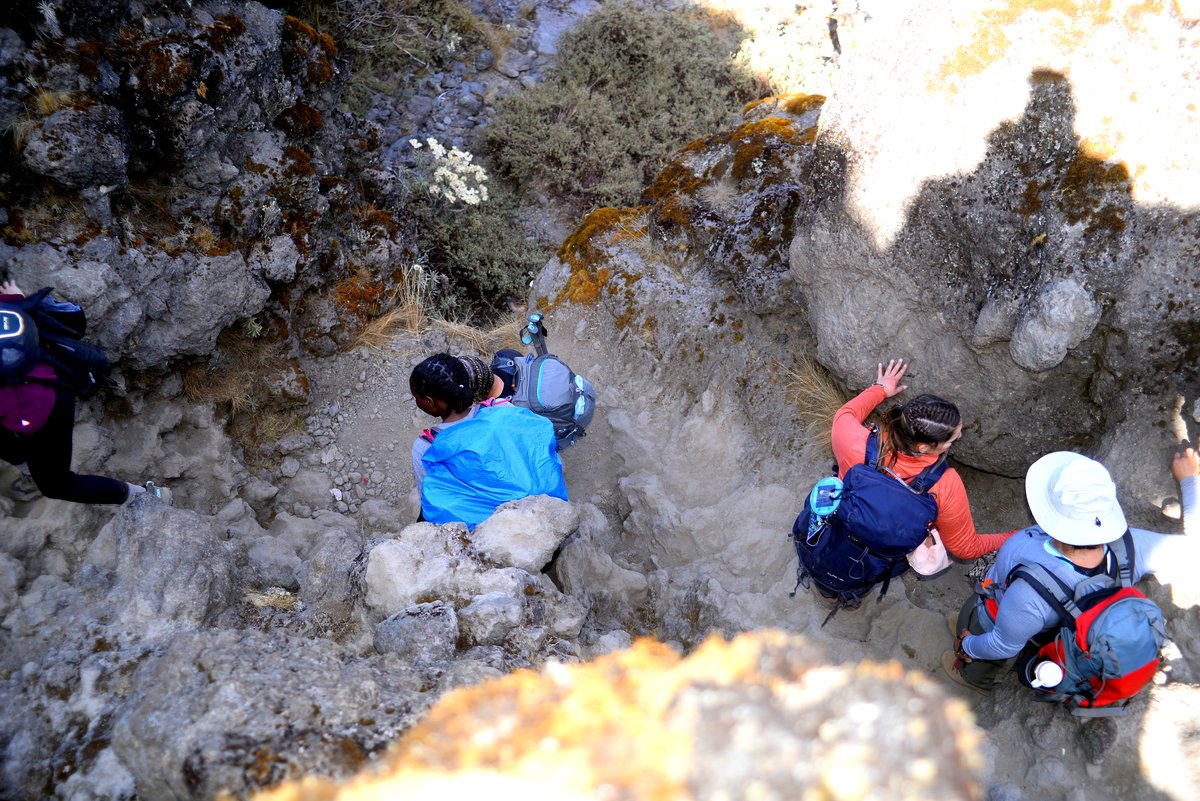
On every standard route there is no rope, no ice axe, no crampons and no climbing skill required. You walk. The single most technical passage on the popular routes is the Barranco Wall, and it is a scramble — hands on rock for perhaps ninety minutes, no exposure that would trouble anybody comfortable on a steep hill path. Porters carry loads up it daily.
If you can walk up a steep hill and occasionally use a hand for balance, you have every technical skill Kilimanjaro requires.
2. Physical difficulty: long rather than intense
This is where the underestimation starts. You are not doing one hard day. You are doing six to nine consecutive days of four to seven hours' walking on uneven ground, at increasing altitude, sleeping badly, eating less than you should — and then a summit night of twelve to fifteen hours that starts at midnight.
Nothing about any individual hour is beyond an averagely fit person. The difficulty is cumulative. By day six you are walking on tired legs with poor sleep behind you, and that is the day before the hardest night.
The specific physical demand people train for least is the descent. It is long, steep, and it arrives when you are most tired. More trips are spoiled by knees on the way down than by lungs on the way up.
3. Altitude: the part that actually decides it
At Uhuru Peak each breath contains a little under half the oxygen of the same breath at sea level. There is no training that changes this at sea level, and fitness offers less protection than people expect — very fit climbers fail regularly, often because they walk too fast early on.
What does help is time. Sleeping altitude, gained gradually, is the mechanism by which your body adapts. Which is why the honest answer to "how hard is Kilimanjaro" is largely "how long is your itinerary".
How hard is it compared to things you may have done?
Rough, non-scientific comparisons that climbers tend to find useful:
- Harder than a multi-day trek at low altitude, however long. Distance is not the issue.
- Harder than a single very hard day — a hilly marathon, a long via ferrata — because it does not stop.
- About comparable to Everest Base Camp in overall demand, though Kilimanjaro gains altitude considerably faster.
- Much easier than any genuinely technical peak. It is not mountaineering.
Who finds it hardest
In our experience the people who struggle most are rarely the least fit. They are:
- Strong, fit people who walk too fast in the first three days and arrive at altitude already depleted
- Anyone on a five or six-day itinerary attempting their first serious altitude
- People who have not walked downhill under load and discover their knees on day seven
- Anyone who has convinced themselves it is a walk-up and packed accordingly
What actually improves your chances
- More nights on the mountain. The single biggest controllable factor.
- Walking slower than feels natural for the first three days. Your guides will nag you about this. They are right.
- Drinking far more water than you want to.
- Eating when you have no appetite, which is most of the upper mountain.
- Training on hills with a loaded pack, including downhill.
- Boots you have already walked fifty kilometres in.
Honest answer about your own chances?
Tell us your walking background and how you have responded to altitude before, and we will tell you which itinerary length we would actually recommend.
More on before you book